PILLOW CULTURE presents PILLOW Pageant: 1 minute films at the NEW JERSEY FILM FESTIVAL
New Jersey Film Festival www.njfilmfest.com/
PILLOW CULTURE and Elizabeth Demaray PRESENT: Twenty-Four Stones I’d Like to Know
Offering visitors a slightly softer rock upon which to sit while viewing DUMBO’s magnificent waterfront, Twenty-Four Stones I’d Like to Know presents nine giant upholstered boulders in Brooklyn Bridge Park. On view as part of the 2011DUMBO Arts Festival, this project is the brainchild of artist Elizabeth Demaray and Pillow Culture. Each stone sports it’s own uniquely fitted cozy-style covering in plush striped fabric and EZ Dri® outdoor reticulated foam. Twenty-Four Stones asks the age old question: can you ever make a stone any softer?
Through this unlikely marriage of materials, Twenty-Four Stones considers the relationship between monumentality and comfort via a familiar object – the pillow. In this unique project, Emily Stevenson and Natalie Fizer of Pillow Culture will be using each rock pattern as a template to re-construct the underlying boulders in order to generate a geometrized version of each stone. Acting as prototypes, each stone will be re-created as part of a limited edition in their Mega Pillow series.
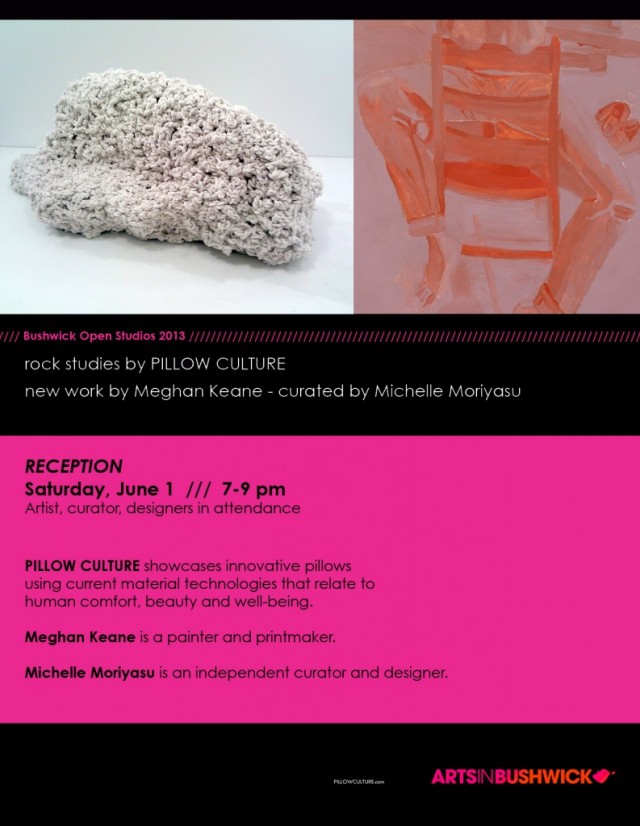
Pillow Culture, co-founded by architects Emily Stevenson and Natalie Fizer, is dedicated to promoting the pillow. Using current material technologies, Pillow Culture designs and produces, as well as collaborates with artists to create innovative limited edition pillows that relate to human comfort, beauty, and well-being.
New York artist Elizabeth Demaray knits sweaters for plants, fabricates alternative housing for hermit crabs and famously familiarized a 10-ton Nike-Hercules Missile by upholstering it in 400 sq. ft. of satin.
Thank you to our sponsor Crest Foam for their generous contribution of EZ Dri® outdoor foam.
2011 DUMBO Arts Festival, Brooklyn Bridge Park – Main Street Friday September 23 6-9pm, Saturday September 24 12-8pm, Sunday September 25 12-8pm
PILLOW CULTURE presents PILLOW Pageant exhibition
Despite its role as a universal sleep-aid, the pillow escapes scrutiny as a designed object. Although anthropologists have studied pillows of pre-industrial cultures, the modern pillow has emerged through the realms of art and invention. Works such as Andy Warhol’s Silver Clouds, Yayoi Kusama’s Pillow, and Marina Abramovic’s stone pillows, demonstrate that the pillow can be a medium for both creative and critical inquiry.
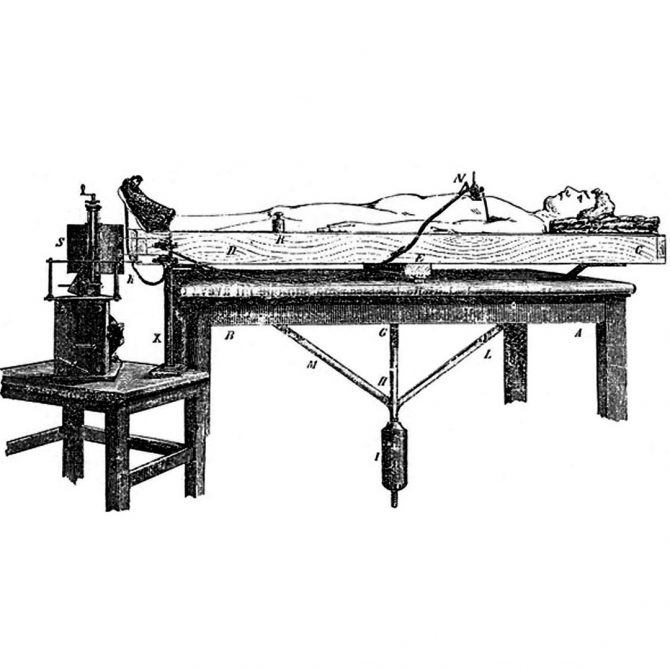
The modern pillow is also a technological artifact that has been the object of a sustained effort at improvement and innovation. Submissions to the U.S. Patent Office document attempts to improve the pillow – to augment, bolster, and protect the body – as well as to invent new pillow prototypes. Brought together in this exhibit, the pillows of artists and inventors offer a record of changing notions of comfort, hygiene, prosthetic support, beauty, and intimacy. Thus, PILLOW Pageant seeks to draw upon these two strains of pillow-making as a means to catalog a cultural history of the pillow.
The curators assembled PILLOW Pageant through an open call for works that responded or referred to a pillow documented under a U.S. patent. This exhibit catalogs the submitted works as well as the U.S. patents the artists took as their point of departure. In addition, some pillows are the subject of a short film that documents either the process of its making or extends its engagement with a given patent. The collection of films and images below comprise the first of A.I.R. Gallery’s online exhibit programs.
We express our sincerest thanks to: Kat Griefen, Director of A.I.R. Gallery, for her support and patience, Kay Turner, Folk Arts Director, Brooklyn Arts Council, for her sage advice, and our diligent assistants Antia Cea and Emma Golden. Special thanks to our photographer Claudia Hehr, filmmaker Michael Keane, graphic artist Laura Foxgrover, Glenn Forley, Eric Payson, Dottie and Marty Payson.
Donor and Sponsors: We Love Colors DelStar Golden Paints
Emily Stevenson + Natalie Fizer curators and founders of PILLOW CULTURE
La Vie en Rose
artist: Anne Ferrer
filmmaker: Theodora Johnson
1905 Pneumatic Pillow, L.F. Doellinger U.S. patent no. 795,108
This inflatable work references several categories of colossal pillows typically found in public spectacles such as parades, festivals and carnivals as well as large scale pillows used in a variety of industries. La Vie en Rose, or life in pink, evokes the French chanteuse whose breath can fill or deflate a gargantuan space.
Night Terror
artist: Chrissy Conant
1932 Combination Pillow and Coverlet, C.K. Longletz U.S. patent no. 1,871,003
Night Terror, pairing the Azz pillows with the Emergency Blanket, is a response to the inner battle between security and anxiety, real or imagined, and evokes a nostalgic longing for serenity. The project also alludes to a solution outside oneself and the possibility of being exploited or controlled by the marketing of fear. These are causes for conversation. However uncomfortable the chatter may be, it may be therapeutic.
Upholstered Stone
artist: Elizabeth Demaray
filmmakers: Owen Donovan & Takeshi Fukunaga
1950 Adjustable Pillow Block, L.B. McGuffage U.S. patent no. 2,521,530
Upholstered Stone is part of a series of items that have been upholstered, including discarded shoes, bricks, tin cans, and 10-ton Nike Hercules Missile. The stone was measured, thinly padded, and then upholstered. The upholstery pieces are affixed to the stone without direct attachment, with each seam stressing the object inside. Viewers are invited to consider for themselves if it is really possible to make a stone any softer.
AfterShock: Marine Life Emergency Pillow
artist/filmmaker: Jennifer Zackin
1923 Pillow, Marine Life Saving Belt and the Like, M.M. Dessau U.S. Patent no. 1,470,598
Aftershock references the 1923 U.S. pillow patent Marine Life Saving Belt and the Like. Conceived to raise awareness about the 2010 B.P. oil spill in the Gulf of Mexico, and the state of emergency of aquatic life, this work serves as a reminder of our dependence on fossil fuel. The pillows are made of brightly colored tights, stuffed alpaca fleece, and sheep wool, covered in orange mesh, and will be used to sponge up the decades-long Gowanus Canal oil leak in New York City.
Plant Press Pillow
artist/filmmaker: James Walsh
1925 Combination Automobile Cushion and Pillow, E. A.Eiband U.S. patent no. 1,540,685
This pillow is designed to further the fieldwork of the amateur or professional botanist. It suggestively serves both as a plant press and as a napping pillow for the weary collector of botanical specimens.
Pillow Pods
artist: Lauren Kogod
filmmakers: Takeshi Fukunaga & Owen Donovan
1966 Mortician’s Block, C.W. Rector U.S. patent no. 3,234,623
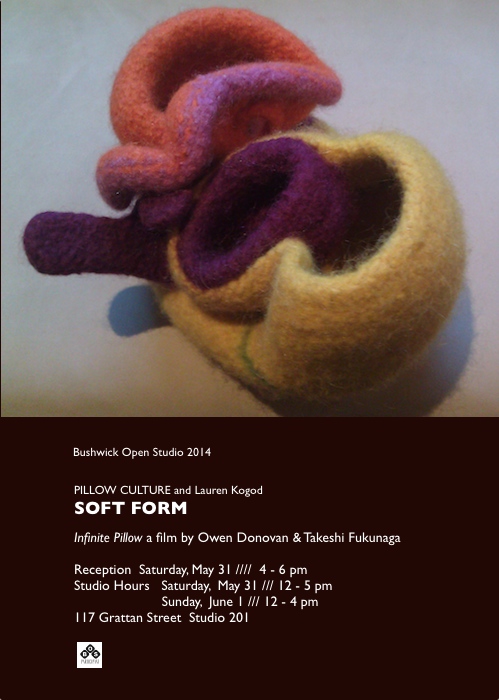
Alluding to a U.S. patent for a “device by the use of which the mortician can maintain limp body elements of a corpse–head, arms, and feet, in particular–in a desired attitude,” The Infinite Pillow is constructed of a succession of supportive pods with alternating valleys. These pods can be fabricated to any desired length, and can be arranged in a plurality of positions for the maximum of corporeal comfort.
Orieller: Listening Pillow
artist/filmmaker: Alyce Santoro
1964 LIstening Pillow, C.L. McLean, U.S. patent no. 3,141,179
Inspired by a patent filed in 1964 for a Listening Pillow, an apparatus to facilitate listening to music in stereo while lying on one’s side, this design has been updated considerably to appeal to modern, nature-deprived audiences. Worn as a headpiece with a tuft of copper wool, the pillow serves as a conductor between the ear of the wearer and natural objects.

PIllow Cake
artist: Vadis Turner
filmmaker: Thomas Dudley
1926 Boudoir Pillow, E.G. Sevier U.S. patent no. Des. 71,533
There is a transformative legacy in handmade objects historically made by women. Over time, ancestral crafts appreciate in value, maturing into heirlooms and later into artifacts that function as cultural currency. The heirloom also serves as a documentation of the artist and her origins in a current cultural context. Thus, the decorative Boudoir Pillow, found in the U.S. patent records, is here transformed into a figurative bridal cake.
BP Beauty Pillows
artist: Meghan Keane
filmmaker: Michael Keane
1967 Curler Pillow, E. F. Eller U.S. patent no. 3,319,272
Inspired by a pillow patent that strives to keep the curlered heads of women in static perfection, these pillows interpret notions of vanity and comfort with a formal playfulness oscillating between the beautiful and the strange.
Come Along Cushion
artist: Gay Brown
2002 Support Pillow, Everhart U.S. patent no. 6,360,387
Referencing a number of fertility pillows catalogued in the U.S. Patent Office, and explicitly ministering to post-menopausal sex and comfort, Come Along Cushion is ultimately functional and life-improving, addressing a basic component and neglected phase of life.
Flotation Pillow
artist: Natalie Fizer
1960 Slumber Pillow, Frances Hayes U.S. patent no. 2,961,668
Flotation Pillow references a 1960 patent for a slumber pillow intended to comfort children susceptible to nervousness upon bedtime. Constructed of recycled Styrofoam, rubber, and foam, it is offered as a buoyancy device to enhance dreaming while floating in water.

Pillow Walk
artist/filmmaker: Daria Dorosh
1938 Combination Pillow and Dressing Case, W. Beehler U.S. patent no. 2,293,530
Pillow Walk is a small, portable textile sculpture carried like a handbag or a fashion accessory, though without functionality. The 1938 pillow patent by W. Beehler inspired the use of a zipper and handles that signal portability and interior space. In this case, the interior of the mind is the content, spilled out onto the surface. The date of the patent coincides with WWII, when refugees fled with possessions that could only be carried by hand. Pillow Walkis both a sad and celebratory reference to precious objects and memories carried, left behind, or lost.

Lola Almohada
artist: Paula Barragan
filmmaker: Fritz Boonzaier
1932 Pillow, N.Arnold U.S. patent no. Des. 86,345
In Spanish, Lola is a diminutive for Dolores, meaning grief and pain. This pillow has a name but not an identity. It is like a guardian angel for all seasons. A tender body pillow for night, comfortable when loneliness and regret float in the darkness, its warm texture carries one safely into the morning light, fullfilling the need for love, company, and caresses. Sometimes, Lola must comfort the sleeping person or wipe an occasional tear.
Pinus Strobus
artist: Barbara Siegel
filmmaker: Augusta Palmer
1927 Sleeping Pillow, P.J. O’Leary U.S. patent no. 1,617,822
Pinus Strobus Pillow is based on a patent filed in 1927 by Edward M. Murphy for a sleep-inducing pillow “with an aromatic pocket to be sewn on the surface thereof.” The particular concept and design of the pillow was inspired by the work of horticulturist Sidney Waxman (1923-2005), who dedicated a lifetime to propagating at least 40 varieties of beautiful and aromatic dwarf conifers. The scent of pine oil embedded in green pine cone pockets on the surface of the pillow is meant to induce sweet dreams.
HaPiBo Pillow
artist: Helene Renard
filmmaker: Ben Berlin
1970 Combination Pillow and Crash Helmet, S. Young U.S. patent no. 3,538,508
HaPiBo is a multi-functional object made of felt. Smash your face into it, wear it on your head, or pop it into a Priority Mail box and mail it to a friend. This pillow is from a line of works tailored to shipping containers and reconfigurable for a number of uses. The pillow can be transformed into another object through a series of folds or simple repositioning.
Combination Pillow and Crash Helmet
artist: Melissa Stern
filmmaker: Max Friedlich
1970 Combination Pillow and Crash Helmet, S. Young U.S. patent no. 3,538,508
The pillow crash helmet, originally conceived for use on airplanes, unites notions of comfort and danger into one object. At once a soft headrest and a protective device, the crash helmet pillow is the accessory of choice whether sleeping soundly after a long business trip or hurtling to earth.